
 Por Ismael Buendia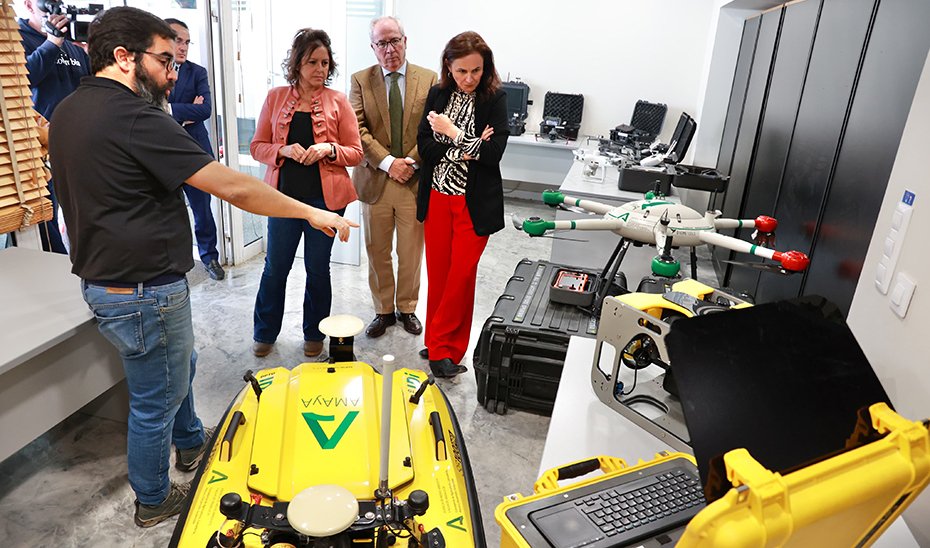
The Sustainability and Environment Counselor of the Andalusian Government, Catalina García, visited the facilities of the Environmental and Water Agency (Amaya) to get a first-hand look at the Andalusian Reference Laboratory for Air Quality (Larca) and the Center for Environmental Quality Data (CDCA). Both centers play a «fundamental role» in monitoring air quality in Andalusia, ensuring the reliability of the data provided by the Air Quality Monitoring and Control Network of the autonomous community, the most extensive in Spain with 94 fixed stations distributed throughout the territory.
During the visit, García highlighted the importance of the work carried out at these facilities, emphasizing that «Andalusia has established a cutting-edge structure for environmental monitoring, allowing us to effectively respond to the challenges posed by air quality and its impact on public health and the environment.» In this sense, she praised the efforts of the Regional Government in the continuous improvement of these systems, with an investment of over 1.26 million euros since 2019 in acquiring mobile units and state-of-the-art equipment to enhance the analytical capacity and response to episodes of air pollution.
The Andalusian Reference Laboratory for Air Quality (Larca), operational as such since 2013, is one of the two only reference laboratories in this field at the state level. Its creation as a laboratory dates back to 1998, and in 2001, it became the first in the country to receive ENAC accreditation (National Accreditation Entity) for conducting tests in the chemical and fluid areas of atmospheric emissions and immissions. However, it was not until 2013 that it became a reference center in Spain.
Its main function is managing the quality of data from all stations in the Air Quality Monitoring and Control Network. To do so, it carries out verifications, calibrations, and audits that ensure the accuracy of the measurements, as well as organizing inter-laboratory comparison exercises involving public bodies and private companies in the sector.
Last week, the Larca organized a nationwide intercomparison exercise to assess the accuracy of measurements from accredited air quality laboratories. From March 17 to 21, it brought together nine specialized companies from different autonomous communities in Seville, which worked with their own equipment in the Agency’s mobile units. «This initiative, pioneering in its format, positions Andalusia as a technical benchmark nationally,» she asserted.
During the exercise, participants calibrated atmospheric pollutant analyzers such as carbon monoxide, sulfur dioxide, ozone, benzene, or PM10 particles, among others. In addition to providing the analyzers, Larca conducted measurements before and after each intervention to ensure the stability of the equipment. Based on the results obtained, the laboratory prepares a statistical study that evaluates the accuracy of each participant against a consensus value. This type of exercise, as detailed, is essential for maintaining quality accreditations before ENAC, and until now, it had not been carried out in Spain using this methodology.
On the other hand, the Center for Environmental Quality Data (CDCA) monitors continuously, 24 hours a day, 365 days a year, the information collected by the surveillance network. This control system, with more than two decades of experience, is a reference in Europe and has helped improve the response capacity to pollution episodes, as well as the design of strategic plans to enhance air quality in Andalusia.
The counselor highlighted that «the Andalusian Government has committed to precise and continuous monitoring of air quality, allowing us to provide rigorous information to the public and implement effective measures to protect health and the environment.» Likewise, she praised the work of Amaya’s technicians in this field, whose work has been crucial for launching specific measurement campaigns and improving protocols for environmental quality action.
Advanced technology for environmental management
In addition to air quality analysis, the Andalusian Environmental and Water Agency is incorporating state-of-the-art technological tools for forest management and environmental control. In this context, Catalina García was able to learn in detail about the devices that Amaya uses for data capture in the field, highlighting the role of drones, rover vehicles, and advanced sensor systems.
The Agency has a fleet of 11 drones operated by 12 certified pilots, making it the first drone operator in the Andalusian Government. These devices allow for information gathering in hard-to-reach areas without risking technical personnel and are equipped with specialized sensors for cartography production, monitoring of protected flora and fauna species, detection of invasive species, or assessment of the status of aquatic ecosystems through sampling in contaminated environments.
In addition to aerial drones, Amaya has added underwater exploration equipment, such as an ROV vehicle capable of operating up to 300 meters deep, facilitating the monitoring of marine ecosystems and the surveillance of invasive species in Andalusian coastal waters. These systems are complemented by an unmanned vessel equipped with side-scan sonar, allowing for bathymetry in rivers and reservoirs for sedimentation analysis.
One of the most innovative devices presented was the ‘Mobile Mapping’ system, a technology that enables massive data capture through spherical cameras installed on off-road vehicles, generating 360° models similar to those of ‘Google Street View’. This tool facilitates georeferencing of elements in the natural environment, optimizing fieldwork times and improving the accuracy of environmental analyses.
The counselor emphasized that «the incorporation of these tools represents a qualitative leap in environmental management in Andalusia, allowing us to improve efficiency and safety in fieldwork.» She also noted that the investment effort in these equipment, which has reached two million euros since 2019, reflects the commitment of the Regional Government to modernizing environmental monitoring and control systems.
As part of this technological modernization, Catalina García also supervised the operation of the eight forest management rover vehicles, an innovative remote-controlled clearing system that enhances worker safety in hard-to-reach areas. These units, acquired in 2024, have caterpillar traction and can operate on slopes of up to 55 degrees, significantly reducing the risks associated with such tasks and enabling more efficient management of forest lands.
The counselor highlighted the Andalusian Government’s commitment to innovation in natural resource management, ensuring that «thanks to these technological advances, we can optimize resource utilization and improve fire prevention, as well as the conservation of our natural spaces.» In this regard, she underscored the importance of continuing to promote the development of innovative solutions that contribute to sustainability and environmental protection.
Also present during the visit were the Secretary General of Environment and Climate Change, María López Sanchís; the Managing Director of AMAYA, Javier de Torre; the Director of Environment and Sustainability of AMAYA, Ignacio Morales; the Director of Corporate Services and R&D Technical Services, Jesús Crespo, and the Director of Water Management and Environmental Quality, María Luisa López Cánovas, among other authorities.
Amaya in figures for 2025
The Andalusian Environmental and Water Agency will have a total budget of 171.4 million euros in 2025, financed through self-financed resources (100 million), orders from own media received (29.8 million), European funds (FEADER 35.6 million and other European funds 1.4 million), and earmarked income (4.6 million).
Regarding managed facilities, the agency oversees 126 centers throughout Andalusia, including 88 public-use facilities (such as visitor centers, marked trails, or recreational areas) and 38 other environmental and natural resource management installations. These infrastructures are distributed across the eight Andalusian provinces, with Cádiz leading in the number of facilities (22), followed by Granada (21) and Jaén (20).
In terms of planning, Amaya develops a Management Program with operational objectives and 68 key indicators, as well as an Annual Action Plan with 371 actions and 636 monitoring indicators, representing almost half of the agency’s overall indicators.
In human resources terms, Amaya has 1,558 employees, distributed across different professional groups. Among them are technicians and specialists, as well as auxiliary and base personnel. This workforce specifically includes 308 employees with job continuity from INFOCA, reinforcing the operational capacity of the agency in fire prevention tasks, as well as in natural resource management.