
 Por Ismael Buendia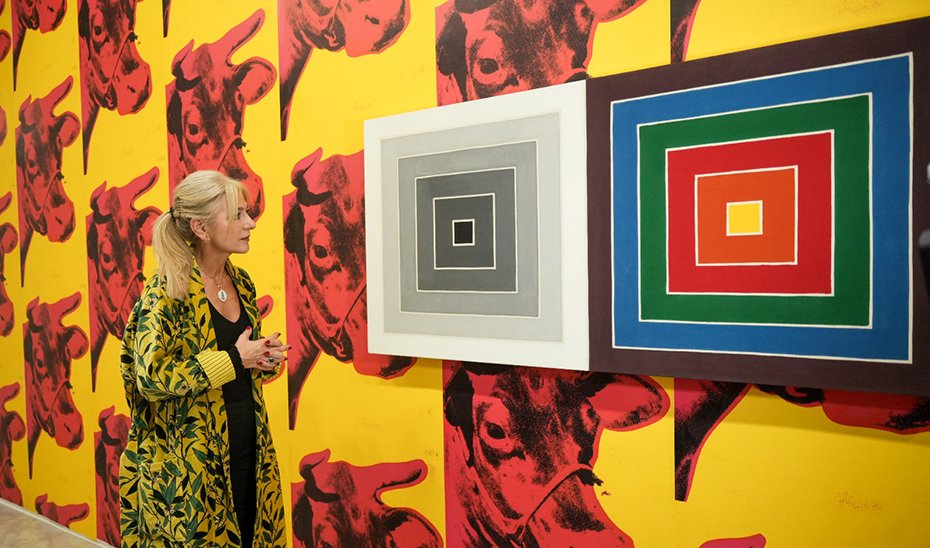
The Andalusian Center for Contemporary Art (CAAC), under the Ministry of Culture and Sports of the Andalusian Regional Government, has inaugurated the exhibition ‘Sturtevant: the echo of innovation’, the first major exhibition in Spain dedicated to the groundbreaking work of this author (1924, Lakewood, Ohio – 2014, Paris).
The exhibition, which will be on display until the end of September, commemorates the centenary of the birth of the artist known for a production that repeats iconic works of her contemporaries, thus questioning the foundations of originality, authorship, and the systems that define the world of contemporary art.
According to the Minister of Culture and Sports, Patricia del Pozo, Sturtevant’s exhibition represents «one of the most ambitious and relevant proposals in the programming of the Andalusian Center for Contemporary Art for this season.» Indeed, the exhibition is composed of «more than 40 works from prestigious museums, such as the Whitney Museum of American Art in New York or the Pinault Collection in Paris, as well as several private collections, highlighting the great work of the CAAC to establish ties of dialogue and collaboration with international artistic institutions,» in the words of Del Pozo.
«Sturtevant replicated works by influential artists such as Andy Warhol, Jasper Johns, Roy Lichtenstein, and Marcel Duchamp, imprinting them with her own seal and thus putting them in front of their own mirror,» summarized Patricia del Pozo, emphasizing the importance of the trajectory of this artist, «very little known in Spain, whose work delved into the function of art as a space to question our reality.»
The exhibition features over 40 works by the American artist, spanning from the 1960s when she began meticulously repeating works by Andy Warhol, Robert Rauschenberg, Jasper Johns, Frank Stella, Robert Rosenquist, and Marcel Duchamp, to reinterpretations of works by a new generation of artists in the 1990s and 2000s, including Robert Gober, Felix Gonzalez-Torres, and Joseph Beuys, among others.
Located in the halls of the East Cloister and the Chapel of Afuera of the CAAC, the exhibition has been conceived as an immersive experience where the works dialogue with each other, such as the piece ‘Beuys Fat Chairs’ (1992), positioned in front of ‘Duchamp Fresh Widow’ (1992).
Among the most prominent works on display is ‘Warhol Black Marilyn’ (2004), a reproduction of Andy Warhol’s iconic Marilyn Monroe series, and ‘Duchamp 1,200 Coal Bags’ (2008), a piece from the Pinault Collection that revisits the installation originally created by Duchamp in the 1930s. «These pieces are not imitations, but conceptual inquiries that expose the power dynamics of art and the market that shape the cultural significance of art,» points out Jimena Blázquez, director of the CAAC and curator of this exhibition.
The corridors of this exhibition space are lined with other works by Sturtevant such as ‘Warhol Cow Wallpaper’ (1966), ‘Warhol Flowers’ (1964/70), ‘Stella Arbeit Macht Frei’ (1989), and ‘Johns Flag’ (1966). The exhibition also houses other fundamental works such as ‘Gober Partially Buried Sinks’ (1990), which examines how individual narratives are absorbed and resignified by cultural institutions.
Lastly, the Chapel of Afuera of the CAAC hosts two of Sturtevant’s most emblematic installations dedicated to the Cuban-American artist Felix Gonzalez-Torres: ‘González-Torres, Untitled (Blue Placebo)’ and ‘González-Torres, Untitled (America)’, both from 2004.
Elaine Sturtevant
Elaine Frances Sturtevant (1924, Lakewood, Ohio–2014, Paris), known as ‘Sturtevant’, is a prominent figure in conceptual art, famous for questioning originality and authorship. She studied psychology at the University of Iowa, philosophy at the University of Zurich, and art at the Cleveland School of Art and the Art Students League of New York, developing a critical and conceptual approach.
In the 1960s, she burst onto the New York art scene by meticulously repeating works by artists such as Andy Warhol, Jasper Johns, and Roy Lichtenstein. A phrase by Warhol, ‘Ask Sturtevant’, symbolizes her technical ability and her challenge to perception.
After a hiatus in the 1970s, she resumed her practice in the late ’70s, incorporating artists like Joseph Beuys, Felix Gonzalez-Torres, and Robert Gober into her work.
In 2011, she received the Golden Lion at the Venice Biennale for her career. Until her passing in 2014, her production challenged traditional notions of art in a world mediated by the repetition and circulation of images. Her work remains a reminder of the importance of art as a space to question and redefine the systems that shape our perception and cultural understanding.
‘Sensemayá. Cantos para matar la culebra’, by Claribel Calderius
Coinciding with the opening of Sturdevant’s exhibition to the public, the CAAC has inaugurated the exhibition by Claribel Calderius. Titled ‘Sensemayá. Cantos para matar la culebra’, it is a project specifically created by the Cuban artist for the Chapel of San Bruno at the Cartuja Monastery, which also represents the first solo exhibition in a Spanish institution for the creator.
In this exhibition running until the end of September, Calderius offers a visual and emotional journey that combines tradition, memory, and spirituality. Inspired by Nicolás Guillén’s eponymous poem, the exhibition takes up the figure of the snake as a symbol laden with meanings: regeneration, change, and spiritual power. The artist uses jute fibers, a rustic and organic material, to construct a visual language that resignifies the architecture and history of the place.